Table of Contents
When exploring disability support under the NDIS, many participants compare two common options: an independent support worker and a disability support worker. While both provide essential assistance, the employment model, flexibility, cost structure, and accountability framework differ significantly.
Understanding how an independent support worker works and how this model compares with disability support worker helps participants choose support that aligns with their funding type, risk tolerance, and personal preferences.
What Is an Independent Support Worker?
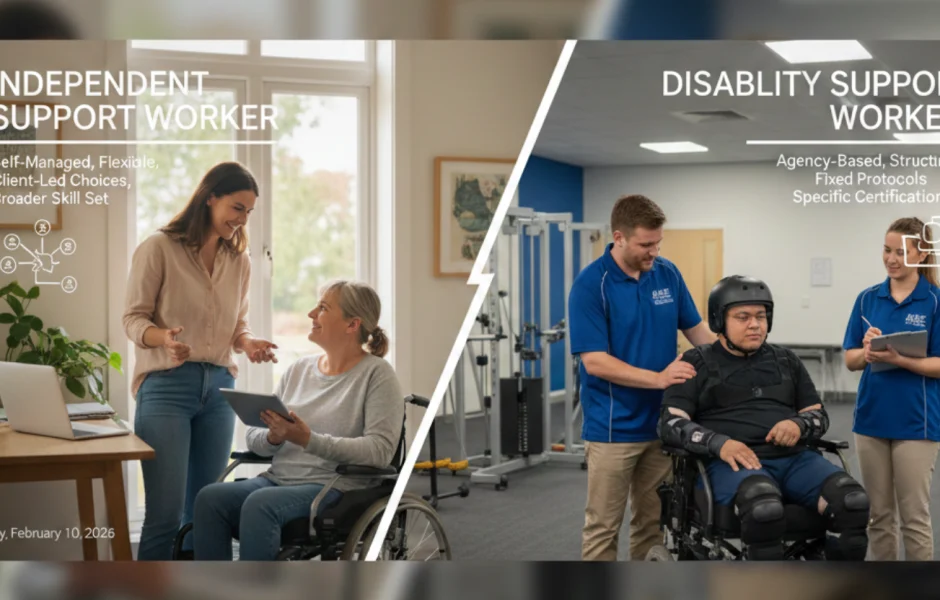
An independent support worker is a self-employed NDIS support professional who is hired directly by a participant rather than supplied through a registered provider.
Independent support workers typically operate as sole traders or contractors. Participants (or their plan managers) pay them directly for approved NDIS supports.
Independent support worker NDIS model characteristics:
- Works directly with the participant
- Not employed by an providers
- Sets their own schedule and rates
- Provides personalised, consistent support
- Often chosen through direct interview and selection
- Common under self-managed or plan-managed NDIS plans
This model is popular among participants who want greater choice, continuity of care, and control over how support is delivered.
What Is a Disability Support Worker?
A disability support worker is typically employed by a registered NDIS provider organisation. The provider recruits, trains, supervises, and assigns workers to participants.
Disability support workers operate within organisational systems and quality frameworks.
Agency-based model characteristics:
- Employee of a registered provider
- Assigned to participants by the organisation
- Covered by provider insurance and compliance systems
- Supervised and quality audited
- Backup staff available if unavailable
- Administrative burden handled by provider
This model suits participants who prefer structured oversight and minimal employment responsibility.
What Sets Them Apart: Key Differences You Should Know
1. Employment Structure
The most fundamental difference lies in the employment arrangement. Disability support workers are employees of an organisation, while independent support workers run their own businesses. This affects everything from how they’re paid to how they deliver services.
2. Flexibility and Control
Independent arrangements typically offer greater flexibility. Participants can negotiate schedules, specific tasks, and service approaches directly with their independent disability support worker. There’s no middleman to coordinate through, making it easier to adjust plans or respond to changing needs.
Disability support workers, while potentially less flexible with scheduling, provide the security of backup support. If your regular worker is unavailable, the agency can arrange a replacement.
3. Cost Considerations
Independent support worker pay rates are often more competitive for participants managing their own NDIS budgets. Without agency overheads, the same hourly rate can translate to better value. However, participants need to factor in the administrative responsibilities that come with self-management, including payroll and compliance with employment laws.
Traditional disability support worker wages through agencies may appear higher on invoices because they include organisational costs. However, they also come with guaranteed backup support and reduced administrative burden for participants.
4. Quality and Accountability
Registered providers undergo regular audits and maintain strict quality standards, and handle complaints formally. Independent workers may offer equally high-quality support, but participants take on more responsibility for quality assurance and risk management.
Independent Support Worker vs Disability Support Worker
| Aspect | Independent Support Worker | Agency-Based Disability Support Worker |
| Employment Status | Self-employed contractor working directly for participants | Employee of a registered NDIS provider organisation |
| Cost Structure | Generally lower hourly rates without agency overheads | Higher rates, including organisational costs and infrastructure |
| Flexibility | High – direct negotiation on schedules, tasks, and approaches | Moderate – operates within agency policies and frameworks |
| Continuity of Care | Excellent – same person consistently if the relationship works well | Variable – may have different workers from the agency pool |
| Administrative Responsibility | Participant manages payroll, super, and compliance | The agency handles all employment administration |
| Backup Support | Limited – participant must arrange alternatives if the worker is unavailable | Strong – agency provides replacement workers when needed |
| Quality Oversight | Participant is responsible for monitoring quality and performance | Regular organisational supervision, audits, and quality checks |
| Complaint Process | Direct resolution between participant and worker | Formal complaints process through agency management |
| Suitable For | Self-managed or plan-managed participants who want control | NDIA-managed participants or those preferring organisational support |
| Selection Process | Participant interviews and choose directly | The agency assigns workers based on availability and needs |
| Payment Method | Direct payment to worker (or via plan manager) | Invoice from registered provider organisation |
The Financial Reality
Understanding cost structures helps you make informed decisions. With the recent DSP increase 2025, more people are examining how to maximise their support budgets.
When you engage an independent support worker, you typically pay them directly, often at rates that reflect their expertise without agency markup. However, you’ll need to manage tax and superannuation obligations. Many participants work with plan managers to handle these administrative elements while still enjoying the benefits of independent arrangements.
Agency-based support worker services include all these administrative costs in their rates, simplifying budgeting and compliance. The higher invoice rate reflects the full package of employment costs, quality assurance, and administrative support.
Which Model Is Right for You?
There is no one-size-fits-all answer. Whether you’re working with an NDIS support worker through an agency or managing your own independent arrangement, what matters most is finding the right support worker—someone who understands your needs, respects your choices, and helps you live the life you want.
Consider an independent support worker if you:
- Have a self-managed or plan-managed NDIS budget
- Value building long-term relationships with consistent support staff
- Want more say in how your support is delivered
- Feel confident managing administrative tasks or have a plan manager to help
- Prefer the flexibility of direct negotiation
An agency-based disability support worker might suit you better if you:
- Are NDIA-managed, or prefer not to handle employment tasks
- Want guaranteed backup when your regular worker is unavailable
- Value the structure and oversight of a registered organisation
- Need specialised support requiring specific qualifications or equipment
- Prefer not to manage employment-related paperwork
Many participants find that a combination works best:
- Perhaps an independent support worker for regular, routine support, and
- An agency relationship for specialised services or backup coverage
Your NDIS plan can accommodate different arrangements for different support types.
Finding the Right Support
If you’d like guidance navigating NDIS supports or finding the right support option for your situation, the team at Clear Care Community is here to help. We work closely with participants to ensure supports are reliable, personalised, and aligned with your goals.
Get in touch today to explore your NDIS support options with confidence.