
Table of Contents
Keeping your home clean, safe, and organised is an essential part of living independently. However, for many Australians living with a disability, everyday household chores can become physically demanding, time-consuming, or even unsafe.
That’s where NDIS Household Tasks funding can make a meaningful difference. Through the National Disability Insurance Scheme (NDIS), eligible participants may receive funding for disability-related domestic assistance that helps them maintain a healthy and comfortable home environment while supporting greater independence.
Whether you are applying for Household Tasks funding for the first time, preparing for an NDIS plan review, or looking to understand exactly what services are covered, this guide explains everything you need to know in 2026.
NDIS Household Tasks funding helps eligible participants who cannot safely complete everyday household chores because of their disability. Funding is generally provided under the Core Supports – NDIS Assistance with Daily Life budget and may cover services such as cleaning, laundry, meal preparation, light household maintenance, and other disability-related domestic tasks.
Funding is only approved when the support is considered reasonable and necessary, directly relates to your disability, and helps you achieve greater independence and safety at home.
What Are NDIS Household Tasks?
NDIS Household Tasks are practical supports that help participants access NDIS Domestic Assistance to manage everyday household responsibilities they cannot safely complete because of their disability. These supports are designed to reduce disability-related barriers and help participants live more independently in their own homes.
Rather than simply paying someone to clean a house, the NDIS funds assistance that removes disability-related barriers to independent living. The goal is to improve participants’ quality of life, maintain a safe living environment, and reduce the risk of injury while encouraging independence wherever possible.
Household Tasks funding is commonly included within the Core Supports – Assistance with Daily Life budget, allowing participants to receive assistance with routine domestic activities based on their individual needs and functional capacity.
Depending on your circumstances, support may be delivered by a registered or non-registered provider, depending on how your NDIS plan is managed.
Why Does the NDIS Fund Household Tasks?
The NDIS recognises that a clean, safe, and well-maintained home contributes to both physical and mental wellbeing.
Without appropriate support, simple household chores may lead to:
- Increased risk of falls or injuries
- Poor hygiene and sanitation
- Higher stress and anxiety
- Reduced independence
- Difficulty maintaining healthy daily routines
- Greater reliance on family or carers
By funding disability-related household assistance, the NDIS enables participants to live more independently while improving their overall health and wellbeing.
Understanding the “Reasonable and Necessary” Criteria
Every support funded through the NDIS must satisfy the reasonable and necessary criteria outlined by the National Disability Insurance Scheme.
Before Household Tasks are approved, the NDIA considers whether the support:
- Is directly related to your disability.
- Helps you pursue your NDIS goals.
- Improves your independence, participation, or safety.
- Represents value for money compared with other support options.
- Is likely to be effective and beneficial.
- Is not more appropriately funded by another government service.
- Is not considered a normal day-to-day living expense unrelated to disability.
For example, if limited mobility prevents you from safely vacuuming or cleaning bathrooms, domestic assistance may be considered reasonable and necessary because it directly addresses disability-related limitations.
What Household Tasks Does the NDIS Fund?
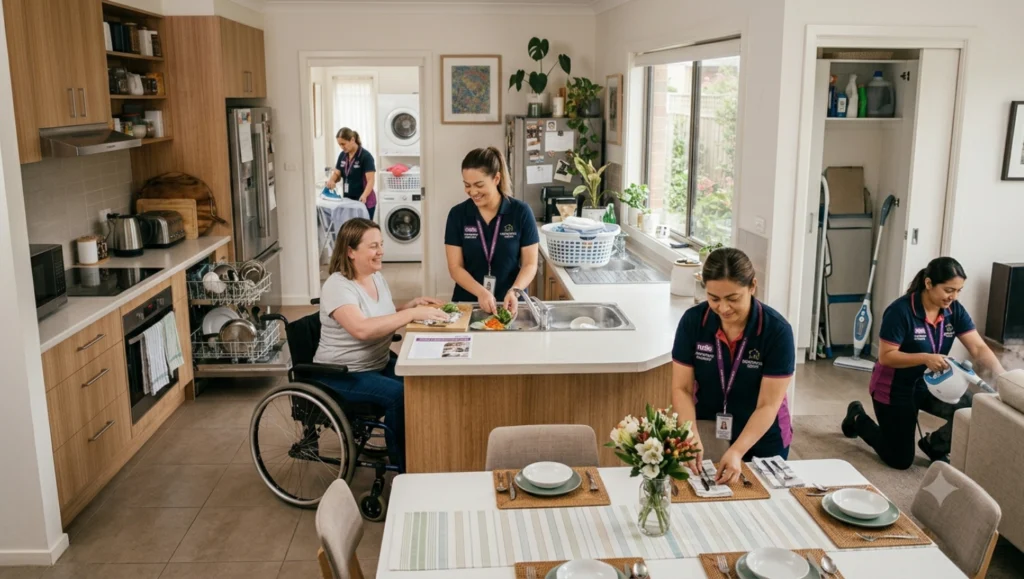
While every NDIS plan is personalised, Household Tasks funding commonly covers essential domestic activities that help participants maintain a clean, safe, and functional home.
| Household Task | Usually Funded |
| Vacuuming and mopping floors | ✓ |
| Dusting surfaces | ✓ |
| Bathroom cleaning | ✓ |
| Kitchen cleaning | ✓ |
| Laundry and folding clothes | ✓ |
| Changing bed linen | ✓ |
| Meal preparation | ✓ |
| Washing dishes | ✓ |
| Taking out rubbish | ✓ |
| Light household organisation | ✓ |
| Sweeping outdoor paths | ✓ |
| Light gardening for safety | ✓ |
These services are tailored to your individual needs and the level of support recommended within your NDIS plan.
What Isn’t Covered?
Although Household Tasks funding is flexible, it does not pay for general lifestyle expenses or services unrelated to your disability.
Examples include:
| Not Usually Funded |
| Grocery shopping costs |
| Cleaning products |
| Vacuum cleaners or appliances |
| Home renovations |
| Furniture purchases |
| Major landscaping |
| Tree removal |
| Roof repairs |
| Pest control |
| General household bills |
The NDIS funds the support worker’s time, not everyday living expenses.
Who Is Eligible for NDIS Household Tasks?
Eligibility depends on how your disability affects your ability to complete everyday household activities rather than your medical diagnosis alone.
You may be eligible if:
- You have an approved NDIS plan.
- Your disability significantly impacts your ability to complete household chores safely.
- Household support is directly related to your disability.
- The support helps you achieve your NDIS goals.
- Informal supports, such as family members, cannot reasonably provide the required assistance.
Every participant’s situation is assessed individually, which means the level of funding varies depending on functional capacity and daily support needs.
What Evidence Helps Get Household Tasks Approved?
Providing detailed evidence significantly improves your chances of receiving appropriate funding.
Helpful supporting evidence may include:
- Functional Capacity Assessment (FCA)
- Occupational Therapist report
- Physiotherapist recommendations
- Medical specialist reports
- GP supporting letter
- Allied health assessments
- Daily living assessments
- Support coordinator recommendations
An Occupational Therapist’s Functional Capacity Assessment is often considered one of the strongest pieces of evidence because it explains how your disability affects daily household activities and recommends appropriate supports.
Examples of When Household Tasks May Be Funded
Every participant has different support needs.
Examples include:
Example 1
A participant living with Multiple Sclerosis experiences severe fatigue after standing for long periods. Vacuuming and mopping increase their risk of falling. Household Tasks funding allows a support worker to complete these chores safely.
Example 2
A participant with cerebral palsy has limited hand function, making meal preparation difficult. Household support assists with food preparation and kitchen cleaning.
Example 3
A participant with autism experiences significant executive functioning challenges that make organising and maintaining the home difficult. Household assistance helps establish routines and maintain a safe living environment.
These examples illustrate how funding is based on functional impact rather than diagnosis alone.
Household Tasks vs Personal Care: What’s the Difference?
Many participants confuse Household Tasks with Personal Care. While both may be funded under Assistance with Daily Life, they support different aspects of independent living.
| Household Tasks | Personal Care |
| Cleaning | Showering |
| Laundry | Dressing |
| Meal preparation | Grooming |
| Kitchen cleaning | Toileting |
| Bed making | Mobility assistance |
| Household organisation | Personal hygiene |
Many participants receive both supports within the same NDIS plan when appropriate.
Can Family Members Provide Household Tasks?
In some situations, family members may provide supports, but the NDIA carefully considers whether this arrangement is reasonable.
Generally, the NDIS expects ordinary family responsibilities to continue. However, if your disability requires additional support beyond what would normally be expected, funding for paid assistance may be appropriate.
Your individual circumstances, living arrangements, and support network will all be considered during assessment.
Can You Choose Your Own Provider?
Yes.
If your NDIS plan is self-managed or plan-managed, you generally have greater flexibility when selecting your preferred provider.
When choosing a provider, consider:
- Experience supporting NDIS participants
- Reliable scheduling
- Qualified support workers
- Flexible service options
- Clear communication
- Positive participant reviews
- Understanding of individual support goals
Choosing the right provider can make a significant difference to your overall experience.
How to Add Household Tasks to Your NDIS Plan
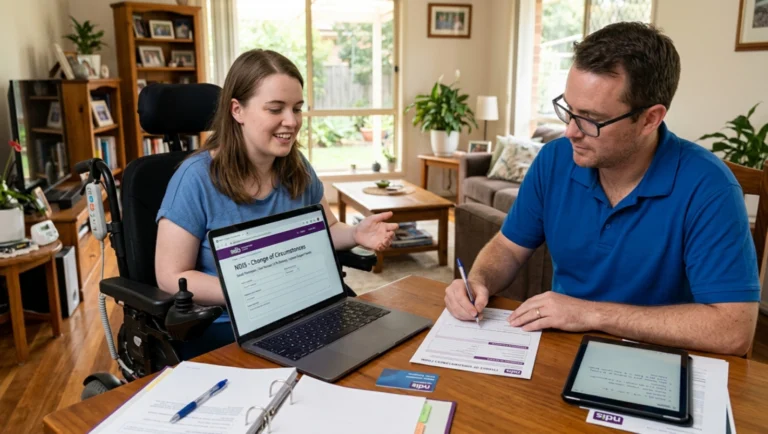
If Household Tasks are not currently included in your plan, you can discuss your changing support needs during your next plan reassessment or request a plan variation if your circumstances have changed significantly.
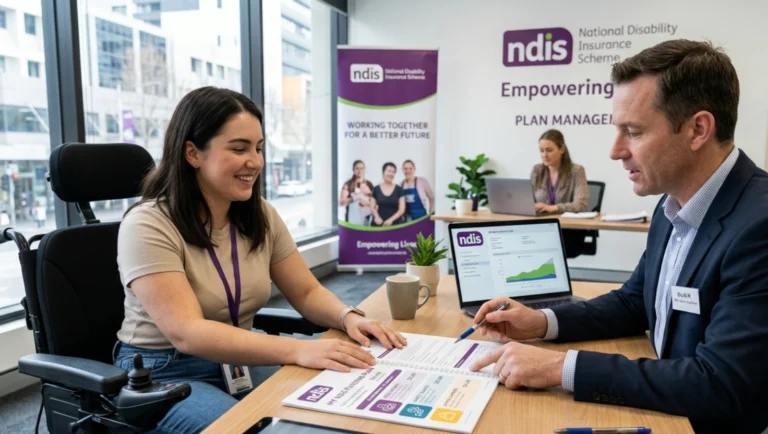
When speaking with your planner or Local Area Coordinator, explain:
- Which household tasks you cannot safely complete.
- How your disability affects each task.
- The risks involved if support is unavailable.
- How the assistance will improve your independence and wellbeing.
Providing practical examples helps demonstrate genuine support needs.
Instead of saying:
“I need help cleaning.”
Explain:
“Due to chronic pain and reduced mobility, I cannot safely vacuum or mop floors without experiencing severe fatigue and an increased risk of falling.”
Specific examples help planners better understand your circumstances.
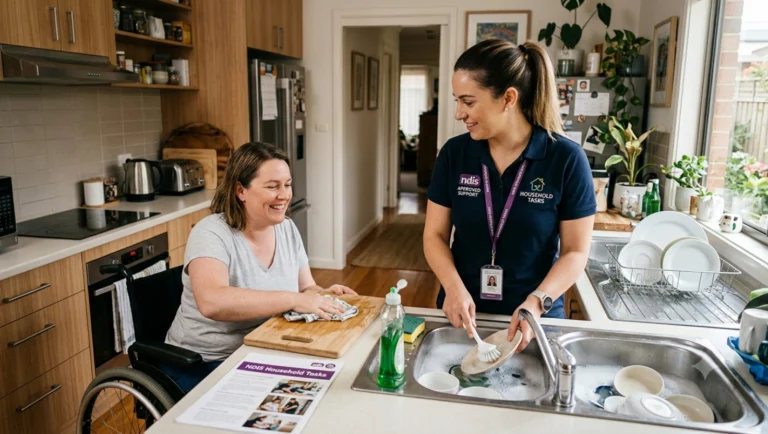
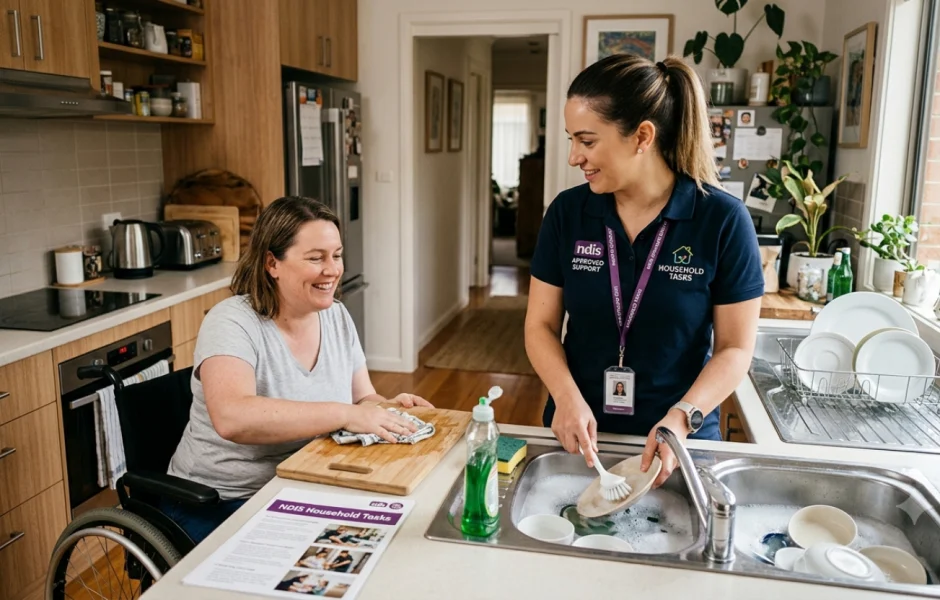
Once your funding is approved, your support worker will work alongside you to complete the approved household tasks while encouraging your independence wherever possible. Depending on your goals and abilities, they may assist with cleaning, laundry, meal preparation, or other daily household activities included in your NDIS plan.
Tips for Maximising Your Household Tasks Funding
To make the most of your funding:
- Keep assessments up to date.
- Document changes in your support needs.
- Set clear NDIS goals related to independent living.
- Work closely with your Occupational Therapist.
- Review your supports regularly.
- Choose providers who understand your individual goals.
- Discuss any changes before your next plan review.
Good planning often leads to better outcomes and more appropriate funding.
Why Choose Clear Care Community?
At Clear Care Community, we understand that every participant’s circumstances are unique. Whether you require regular cleaning, laundry assistance, meal preparation, or professional NDIS Cleaning Services, our experienced support workers provide reliable, personalised assistance that aligns with your goals, preferences, and daily routine.
Whether you need regular cleaning, laundry assistance, meal preparation, or ongoing domestic support, our compassionate team focuses on helping you maintain a safe, comfortable, and independent home environment while respecting your choices and promoting your independence.
We work closely with participants and their support networks to deliver flexible services that align with their NDIS plans and evolving needs.
Final Thoughts
Access to reliable Disability Home Care Services can make everyday living easier, safer, and more enjoyable. As your support needs evolve, choosing a provider that offers flexible, participant-focused care helps ensure you continue receiving assistance that supports your independence and quality of life.
NDIS Household Tasks funding is designed to provide practical, disability-related support that helps eligible participants maintain a clean, safe, and organised home while reducing daily challenges and improving independence.
If you’re unsure whether you qualify or need guidance navigating your NDIS plan, speaking with an experienced NDIS provider can help you better understand your options and access the supports that best meet your individual needs.
At Clear Care Community, we’re committed to delivering personalised Household Tasks support that empowers participants to live with greater confidence, dignity, and independence every day.