
Table of Contents
Navigating an NDIS plan can feel overwhelming when you are staring at different budget pools, wondering where every dollar is allowed to go. And one of the common questions participants ask when receiving their plan is: what can NDIS funds be used for?
Understanding the rules prevents funding delays, avoids plan audit issues, and helps you maximise your support. The National Disability Insurance Scheme (NDIS) splits your total budget into three main support budgets: Core Supports, Capital Supports, and Capacity Building Supports. Within these three budgets sit fifteen specific support categories.
Here is a clear breakdown of these NDIS Funding Categories, detailing exactly what you can and cannot spend each budget on.
The NDIS Reasonable and Necessary Test: The Golden Rule
Before diving into each category, every purchase under your NDIS plan must meet the NDIS “Reasonable and Necessary” criteria. Regardless of which budget category a support falls under, the item or service must meet these fundamental rules:
- Directly related to your disability: It must directly connect to the goals outlined in your NDIS plan.
- Not a day-to-day living cost: It cannot be a general expense that everyone pays for (like standard groceries, rent, or basic utility bills).
- Value for money: The support must provide clear benefit relative to its cost.
- Effective and beneficial: There should be evidence that the support works for your needs.
- Not covered by other systems: It should not be the responsibility of the public health system, mainstream education, or general public transport.

1. Core Supports Budget
Your Core Supports budget is designed to help you with everyday activities, disability-related needs, and social participation. In most cases, Core Supports are flexible: you can often move funds between categories within this budget if your needs shift.
Category 1: Assistance with Daily Life
This covers support for everyday personal tasks that enable you to live as independently as possible at home and in the community.
- What you CAN spend it on:
- Personal care support (assistance with showering, dressing, and meal preparation).
- Assistance with NDIS Household Tasks, including household cleaning, gardening, and yard maintenance related to your disability.
- Short-Term Accommodation (STA) or respite care.
- A support worker can assist with living independently in shared accommodation and provide personalised support based on your daily needs.
- What you CANNOT spend it on:
- General house rent or mortgage payments.
- Standard utility bills (electricity, internet, water).
- Food and groceries (except for the cost of meal preparation and delivery services, where applicable).
Category 2: Transport
Transport Services for Disability funding helps participants who cannot use public transport without substantial difficulty due to their disability, allowing them to access work, education, healthcare, and community activities.
- What you CAN spend it on:
- Taxis, rideshare services, or specialised transport to access community activities, education, or work.
- Direct transport payments (often paid directly into your bank account on a periodic schedule).
- What you CANNOT spend it on:
- Buying a personal motor vehicle.
- General fuel costs for family or friends driving you for general errands.
- Public transport costs that a person without a disability would normally pay.
Category 3: Consumables
Consumables are daily items you need to manage your disability-specific health and hygiene requirements.
- What you CAN spend it on:
- Continence products (pads, catheters, specialised bedding protection).
- Enteral feeding equipment and tubes.
- Low-cost assistive technology (items under $1,500, such as modified eating utensils, non-slip mats, or basic communication cards).
- What you CANNOT spend it on:
- Prescription medications, vaccines, or medical treatments (these fall under Medicare/the health system).
- Everyday personal hygiene items like standard shampoo, body wash, or toothbrushes.
- Tissues, toilet paper, or standard household cleaning sprays.
Category 4: Assistance with Social, Economic, and Community Participation
NDIS Social and Community Participation funding helps you participate in community, social, recreational, and civic activities while building greater independence and confidence.
- What you CAN spend it on:
- Hiring a support worker to accompany you to social outings, sporting events, or personal interest classes.
- Support to attend community groups or volunteer opportunities.
- What you CANNOT spend it on:
- Ticket prices or entrance fees for events, movies, or concerts (for yourself or your support worker).
- Gym memberships (unless specifically approved under Capacity Building with clinical justification).
- Vacation costs, flight tickets, or hotel accommodation costs.
2. Capacity Building Supports Budget
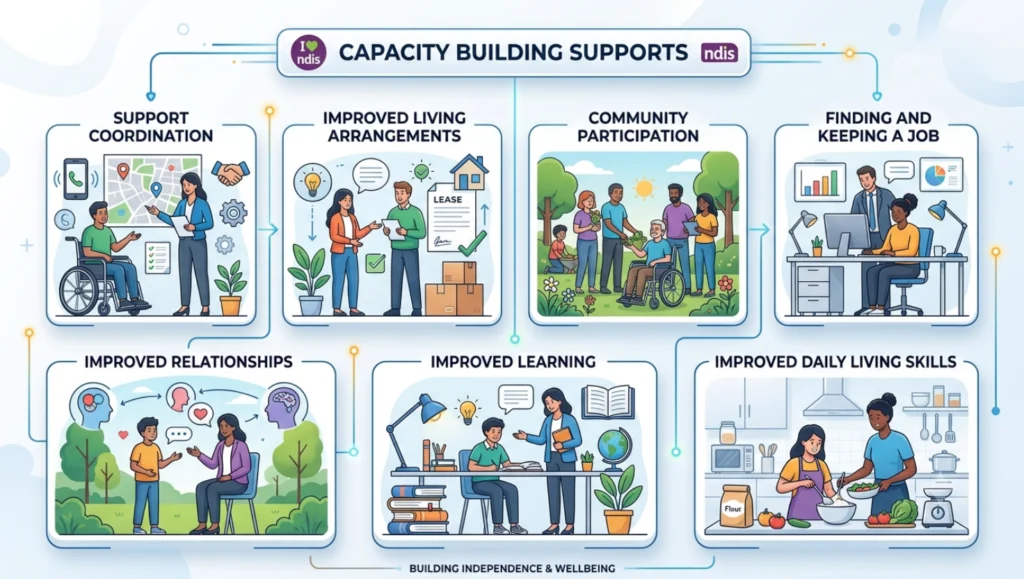
Unlike Core Supports, Capacity Building Supports are non-flexible. Funding allocated to a specific Capacity Building category can only be spent on services within that exact category. This budget focuses on building skills and independence over time.
Category 5: Support Coordination
Provides funding to hire a professional who helps you understand, set up, and implement your NDIS plan.
What you CAN spend it on:
- Level 1: Support Connection: Short-term assistance to help you connect with local community supports and service providers.
- Level 2: Support Coordination: Ongoing coordination to help you establish service agreements, resolve complex delivery challenges, build your network of supports, and prepare for plan reviews.
- Level 3: Specialist Support Coordination: High-level assistance for complex situations or crisis management.
- Psychosocial Recovery Coaching: Specialised support for participants with psychosocial (mental health) conditions.
What you CANNOT spend it on:
- Direct support work (e.g., showering or household cleaning).
- Legal representation or advocacy fees.
Category 6: Improved Living Arrangements
This category provides practical support to help you retain or secure appropriate living options.
- What you CAN spend it on:
- Support to search, inspect, and apply for accessible long-term accommodation or rental housing.
- Assistance with managing tenancy obligations and lease agreements.
- What you CANNOT spend it on:
- Rental bond payments, rent, or home purchase deposits.
- Standard furniture removals or decorative items.
Category 7: Increased Social and Community Participation
Builds specific skills so that you can participate in social and recreational activities independently.
- What you CAN spend it on:
- Life skills training, peer support groups, and mentoring.
- Specialised group activities aimed at developing social skills.
- What you CANNOT spend it on:
- Standard club membership fees, sports gear, or recreational course fees.
- Standard club membership fees, sports gear, or recreational course fees.
Category 8: Finding and Keeping a Job
Designed for participants looking to gain or retain employment in the open labour market or supported settings.
- What you CAN spend it on:
- Individualised employment support, job coaching, and workplace assistance.
- Career counselling and resume-building support adapted for your disability needs.
- What you CANNOT spend it on:
- Higher education tuition fees or TAFE course fees.
- Work uniforms, general tools, or trade licensing fees.
Category 9: Improved Relationships
Focuses on positive behaviour support strategies and social interaction skills.
- What you CAN spend it on:
- Behavioural assessments and specialist positive behaviour support plans created by registered practitioners.
- Training for carers and support workers to implement behaviour support plans.
- What you CANNOT spend it on:
- General relationship counselling or family therapy not tied to disability management.
- General relationship counselling or family therapy not tied to disability management.
Category 10: Improved Health and Wellbeing
Aims to maintain or improve physical wellbeing through specialised allied health services.
- What you CAN spend it on:
- Exercise physiology and dietetics tailored specifically to manage disability-related physical impacts.
- Specialised exercise programs designed by qualified practitioners.
- What you CANNOT spend it on:
- Standard commercial gym memberships, weight loss programs, or meal delivery subscriptions.
- General spa treatments, saunas, or cosmetic treatments.
Category 11: Improved Learning
Assists with transition from school to higher education or vocational training.
- What you CAN spend it on:
- Specialised support and skill development to transition from secondary school to tertiary education or vocational programs.
- Specialised support and skill development to transition from secondary school to tertiary education or vocational programs.
- What you CANNOT spend it on:
- University or TAFE course fees, textbooks, or standard student equipment.
- University or TAFE course fees, textbooks, or standard student equipment.
Category 12: Choice and Control (Improved Life Choices)
Covers plan management fees and financial training to help you administer your NDIS plan.
- What you CAN spend it on:
- Registered NDIS Plan Management provider fees to manage your invoices and budget tracking.
- Training to learn self-management skills for your NDIS budget.
- What you CANNOT spend it on:
- Personal financial advice, tax preparation, or accounting fees.
- Personal financial advice, tax preparation, or accounting fees.
Category 13: Improved Daily Living Skills
This is one of the most frequently used Capacity Building categories, covering therapy services to build functional independence.
- What you CAN spend it on:
- Occupational therapy (OT), physiotherapy, speech pathology, and psychology assessments/sessions.
- Early childhood intervention supports.
- What you CANNOT spend it on:
- Medical appointments, GP visits, specialist consultations, or hospital visits.
- Standard alternative therapies like reflexology or aromatherapy without clinical evidence.
3. Capital Supports Budget
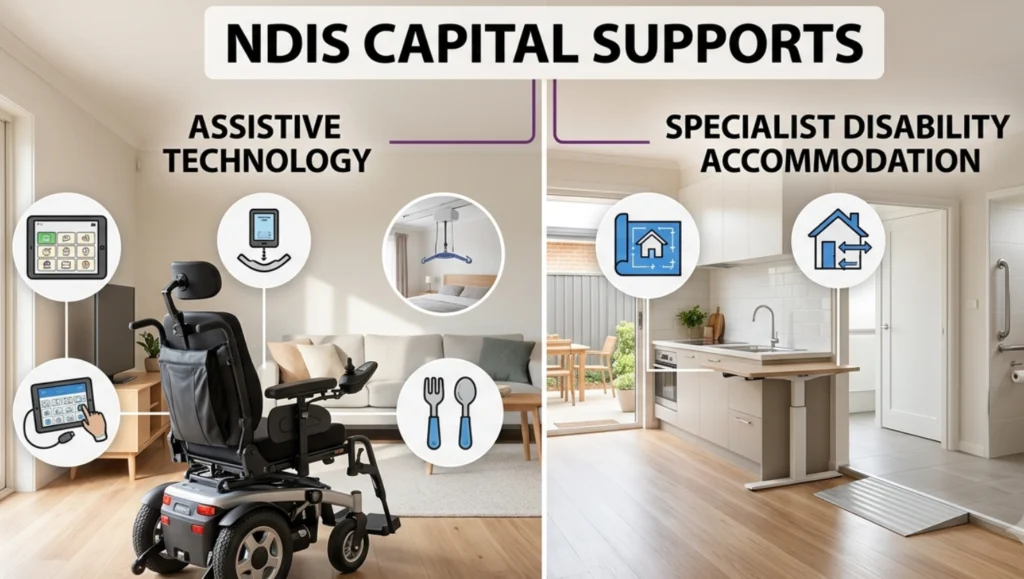
Capital Supports cover higher-cost items, assistive technology, and structural home or vehicle modifications. Like Capacity Building, Capital Supports are strictly non-flexible and must be used as specified in your plan.
Category 14: Assistive Technology (AT)
Covers equipment, technology, and hardware that assists with mobility, communication, and daily functions.
- What you CAN spend it on:
- Manual or motorised wheelchairs, specialised beds, and pressure care cushions.
- Communication devices (AAC speech devices) and specialised screen-reading software.
- Hearing aids and visual aids specifically approved by assessment.
- What you CANNOT spend it on:
- Standard consumer electronics like iPhones, iPads, or laptops (unless specifically approved as a primary AAC communication tool by an OT).
- Repairs for equipment not funded by or registered under your NDIS plan.
Category 15: Home Modifications and Specialist Disability Accommodation (SDA)
Covers structural changes to your home or specialised housing setups.
- What you CAN spend it on:
- Structural alterations like wheelchair ramps, widened doorways, bathroom modifications, or ceiling hoists.
- SDA building funding for eligible participants with extreme functional impairment.
- What you CANNOT spend it on:
- General home renovations, cosmetic updates, or property maintenance.
- Standard mortgage repayments or purchasing standard residential real estate.
Understanding Financial Timelines: How Does NDIS Funding Categories Work?
Many participants wonder: how does NDIS funding work across a plan year?
When your plan is approved, funding is allocated across specific NDIS funding periods (often 12 months, 24 months, or up to 3 years).
Your overall allocation is divided into distinct quarterly or monthly budgets depending on your plan setup (Self-Managed, Plan-Managed, or NDIA-Managed).
It is vital to track your spending regularly and understand the current NDIS Pricing Arrangements, which outline funding limits and pricing rules for approved supports and services. Unspent funds do not automatically roll over into a new plan cycle at the end of a plan period, nor can you “spend ahead” beyond your current allocation without formal plan variations.
How to Access and Apply for Supports
If you do not currently have a plan and are asking how do I apply for NDIS funding, the process involves 3 key steps:
- Verify Eligibility
You must be under 65 years old (when applying), an Australian citizen or permanent resident, and have a permanent and significant disability that affects your ability to take part in everyday activities.
- Gather Evidence
Collect comprehensive medical, clinical, and allied health evidence (from GPs, specialists, occupational therapists) detailing your functional impairment.
- Submit an Access Request
Complete the NDIS Access Request Form (ARF) online or via paper, attaching all clinical evidence, and submit it directly to the NDIA.
Get the Most Out of Your NDIS Plan with Clear-Care Community
Navigating NDIS Funding Categories, tracking budgets, and coordinating therapies can be challenging without the right support network. Having an experienced, empathetic provider ensures you get maximum value from your plan while staying fully compliant with NDIA guidelines.
At Clear-Care Community, we empower participants with care tailored to their unique life goals. Whether you need personal care assistance, community access, or assistance with daily living tasks, our dedicated team is here to support you every step of the way.
Have questions about your current plan or ready to partner with a trusted care provider? Contact Register NDIS Provider in Narre Warren today and let our expert team help you make the most of your NDIS journey.