
Table of Contents
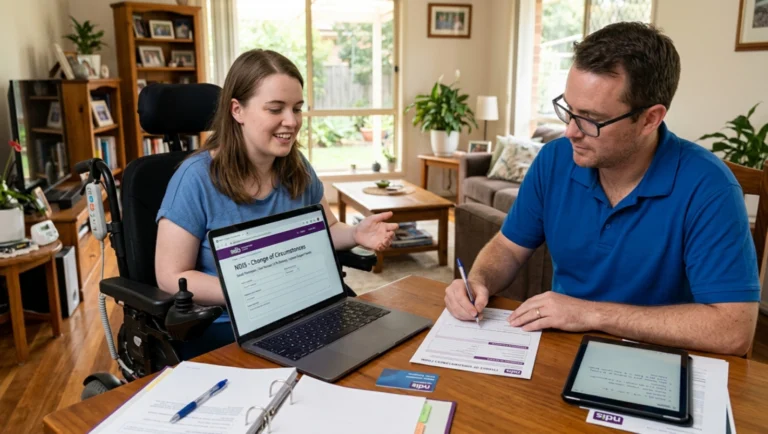
Have you moved house? Have your support needs grown? Is your family carer no longer available to help? Or have you recently changed jobs? Whatever it is, if something significant has shifted in your life, the National Disability Insurance Agency (NDIA) needs to know.
This guide explains what an NDIS change of circumstances actually covers, when you’re expected to speak up, how the reporting process works, what happens to your current supports while it’s being processed, and what the NDIA does with your plan once you’ve reported.
Quick answer: report a change as soon as you become aware of it, ideally within 14 days. The NDIA usually responds within 21 days of receiving everything it needs. A varied plan is issued within 7 days of that decision. A full plan reassessment takes up to 28 days to complete. Your current supports keep running as normal while all of this happens — see What Happens to Your Current Supports While You Wait.
What Does a Change of Circumstances Mean Under the NDIS?
A change of circumstances — officially described by the NDIA as a “change of situation” — is any meaningful change in your life that could affect the support you need, how you’re contacted, or how your plan is managed. Most participants and providers still use “change of circumstances,” so we’ve used both terms throughout this guide.
It’s important to separate two things people often mix up:
- A change of circumstances relates to your personal situation — where you live, your health, your support network, your contact details.
- A change to your plan is what the NDIA might decide to do about it, once they’ve reviewed what’s changed.
Depending on how significant the change is, the NDIA will either leave your plan as is, make a small adjustment (a plan variation), or rebuild your plan entirely (a plan reassessment). We cover the difference between these two in detail below.
What Counts as a Change of Circumstances?
Not every life event needs reporting, but plenty do. Common examples participants and providers report include:
- A change in address, whether local or interstate
- Moving out of residential accommodation or aged care into a new living arrangement
- An updated phone number, email or postal address
- A change in disability support needs — more, less, or different supports
- A shift in your informal support network, such as a carer stepping back or a family member taking on more
- Updated name, pronouns or gender information
- Planning to travel or live overseas for an extended period
- Receiving or claiming compensation connected to your disability
- Starting work for the first time, or a significant employment change
- Being admitted to hospital, having surgery, or receiving a new diagnosis
Some of these are purely administrative and involve updating your file. Others — particularly changes to disability support needs — can trigger a genuine review of your funding.
If your situation is urgent (for example, a sudden hospital admission, the unexpected loss of your only carer, or a safety risk at home), say so explicitly when you contact the NDIA. Urgent, time-limited changes can be handled through emergency or crisis funding as part of a plan variation, rather than waiting for a full reassessment — this is one of the specific scenarios the NDIA’s updated Rules on plan variations now set out clearly.
When Should You Report a Change to the NDIS?
The honest answer is: as soon as you become aware of the change, ideally within 14 days. The NDIA is upfront that waiting too long to notify them means your plan may not reflect what you need, and you could go without the right supports in place until you speak up.
What Happens to Your Current Supports While You Wait?
This is one of the most common worries participants raise, and it’s worth answering directly: your existing plan and current supports keep running as normal while your change of circumstances is being reviewed. Reporting a change doesn’t pause or cancel your funding — it simply starts a review process. If your situation is genuinely urgent, tell the NDIA this when you report the change, and ask about emergency or crisis funding rather than waiting for the standard timeframe.
How Do I Report a Change of Circumstances to the NDIS?
Reporting a change of circumstances is simple. There are four ways to get in touch, and you can pick whichever suits you best.
Call the NDIA directly
Phone 1800 800 110 and explain what’s changed. This is the fastest option if your situation is urgent.
Submit an enquiry through the NDIS Service Hub
The NDIS Service Hub is the online portal for lodging requests without needing to call.
Speak to your support network directly
Talk to your my NDIS contact, support coordinator, or recovery coach, or visit your local NDIS office in person. If Clear Care Community’s support worker team already supports you day to day, we’re often the first to notice a change and can help you flag it early — see how our support team can help below.
Fill out the change of circumstances form
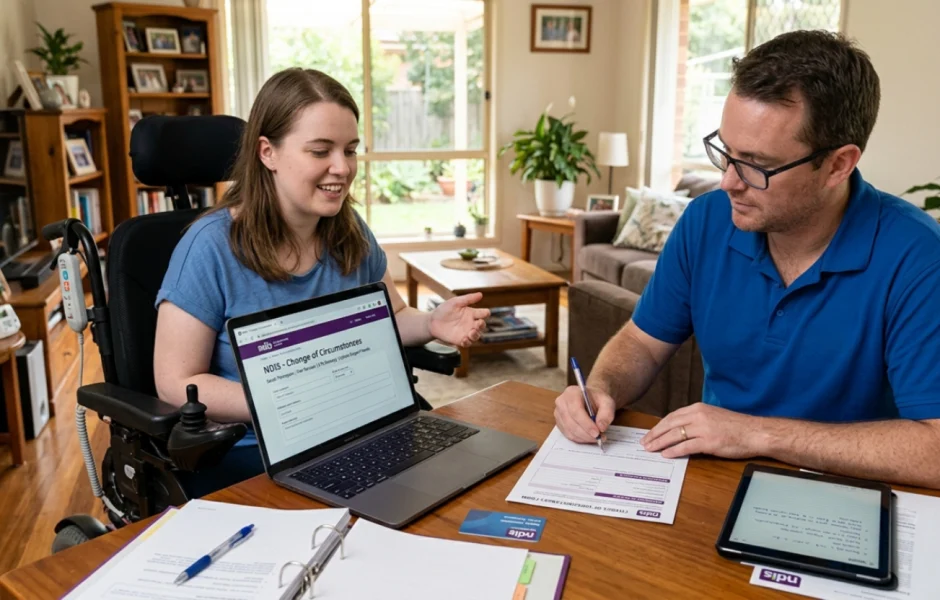
Complete the Change of Details or Change of Situation form, available as a PDF or DOCX download from the NDIS website. It’s broken into four clear sections: your details, third-party details (if you’re completing it for someone else), what’s changed, and a declaration confirming the information is accurate.
Reporting on behalf of someone else: if a third party — a family member, support worker, or support coordinator — is filling in the form, the participant must first give the NDIS consent. This can be done by phone, letter or email, or by submitting a separate Consent for a Third Party to Act on Behalf of a Person form. This matters if you’re a carer or family member reporting a change for someone you support rather than for yourself.
What Evidence Do You Need for a Change of Circumstances Request?
Some changes are simple to report and need nothing more than your word — moving house or updating a phone number, for instance. If your request is about your disability support needs, expect to back it up with documentation.
Reports and clinical letters
Reports or letters from your GP, specialist, or allied health professional describing the change and its impact.
Updated assessments
Updated assessments from an occupational therapist, physiotherapist, or psychologist — often formalised as a functional capacity assessment
Written confirmation from your support team
Written confirmation from a support worker or support coordinator about changed needs, based on what they observe day to day.
A quick example of the difference strong evidence makes: a letter that simply says “this participant needs more support” is usually too vague for the NDIA to act on. A letter that says “this participant now requires an additional 4 hours of personal care support per week following a fall, specifically for showering and dressing, based on daily observation over the past six weeks” gives the NDIA something concrete to assess. Wherever possible, ask whoever is writing your evidence to be specific about hours, tasks, and how long the change has been in place.
If you’re not sure what kind of evidence applies to your situation, your my NDIS contact can point you in the right direction before you submit anything.
Need help gathering the right evidence? Because our support workers are already in your home helping with daily living, personal care, and community access, they’re often best placed to document exactly how your needs have changed — in the specific, detailed way the NDIA responds to. Contact Clear Care Community on 0414 575 779 and we’ll help you get it right the first time.
What Happens to Your Plan After You Report a Change?
Once you’ve told the NDIA about your situation and provided any evidence needed, here’s the general sequence of events:
- Review — The NDIA reviews your current plan to determine whether your needs can already be met by using your existing NDIS funding Categories.
- Decision — If your plan genuinely needs to change, they’ll decide whether it calls for a plan variation or a full plan reassessment.
- Response time — You’ll typically hear back within 21 days of the NDIA receiving all the information it needs to make a decision.
- Outcome — They’ll either vary your plan, replace it with a new one, or confirm no change is required and explain why.
If your plan is varied, you’ll receive the updated version within 7 days.
Plan Variation vs Plan Reassessment: What’s the Difference?
These two pathways come from different parts of the National Disability Insurance Scheme Act 2013 — Section 47A covers plan variations, and Section 48 covers plan reassessments. Updated NDIS Rules now set out exactly when each applies, which is why it’s worth understanding the distinction rather than assuming every change means starting from scratch.
| Aspect | Plan Variation | Plan Reassessment |
| What it is | A smaller, targeted adjustment to part of your existing plan | The NDIA replaces your entire plan with a new one |
| Legislative basis | Section 47A, NDIS Act | Section 48, NDIS Act |
| Typical triggers | Updating goals, shifting your reassessment date, changing how funding is managed, adding short-term or crisis funding | Life has changed significantly enough that your current plan no longer fits, or you need substantially more, less, or different supports |
| Timeframe | Up to 28 days once the NDIA has what it needs | Up to 28 days once the NDIA has what it needs |
| Outcome | Part of your existing plan is updated | A brand-new plan replaces the old one |
Both processes generally take 28 days to complete once the NDIA has the information and evidence it needs from you.
What If the NDIS Doesn’t Approve My Request?
Sometimes a request doesn’t go through — usually because there isn’t enough evidence connecting the change to your support needs, or because the situation doesn’t meet the NDIA’s guidelines for a change.
If that happens, you have the option to:
- Call the NDIA to talk through the reasoning behind the decision
- Request an internal review of the decision
What Happens If You Don’t Report a Change?
If you don’t report a significant change, the NDIS change of circumstances process never gets triggered, and your NDIS plan may no longer reflect your current needs. This can lead to:
- Funding that doesn’t match the support you actually need
- Supports that no longer suit your circumstances
- Missed opportunities to request urgent or emergency support
- More stress and delays if your needs change further
As a simplified example: a participant who moves from a two-storey house into a single-level unit but doesn’t report it might keep receiving funding for home modifications that are no longer relevant, while missing out on updated transport or community access supports that better suit their new location. Reporting the move promptly means the plan can be adjusted to reflect what’s actually needed, rather than what used to be needed.
Reporting changes early helps keep your plan aligned with your circumstances and support needs.
Let Clear Care Community Help You Navigate the Process
Reporting a change of circumstances and preparing for a plan variation or reassessment can feel like a lot to manage on top of everything else going on. Clear Care Community was founded by Suroor Khorasanee, a former NDIS support worker, and today our team delivers hands-on assistance with daily living, disability home care, and transport support to Community participants across Narre Warren and greater Melbourne.
Because we’re already involved in your day-to-day support, we’re often the first to notice when your needs have genuinely changed — and we can help you document that change clearly, adjust your support roster in the meantime, and understand what evidence your request will need.
If your circumstances have shifted and you’re not sure what that means for your plan, contact Clear Care Community today on 0414 575 779 or info@clearcarecommunity.com.au. We’re here to make sure your NDIS supports keep up with your changing needs.